

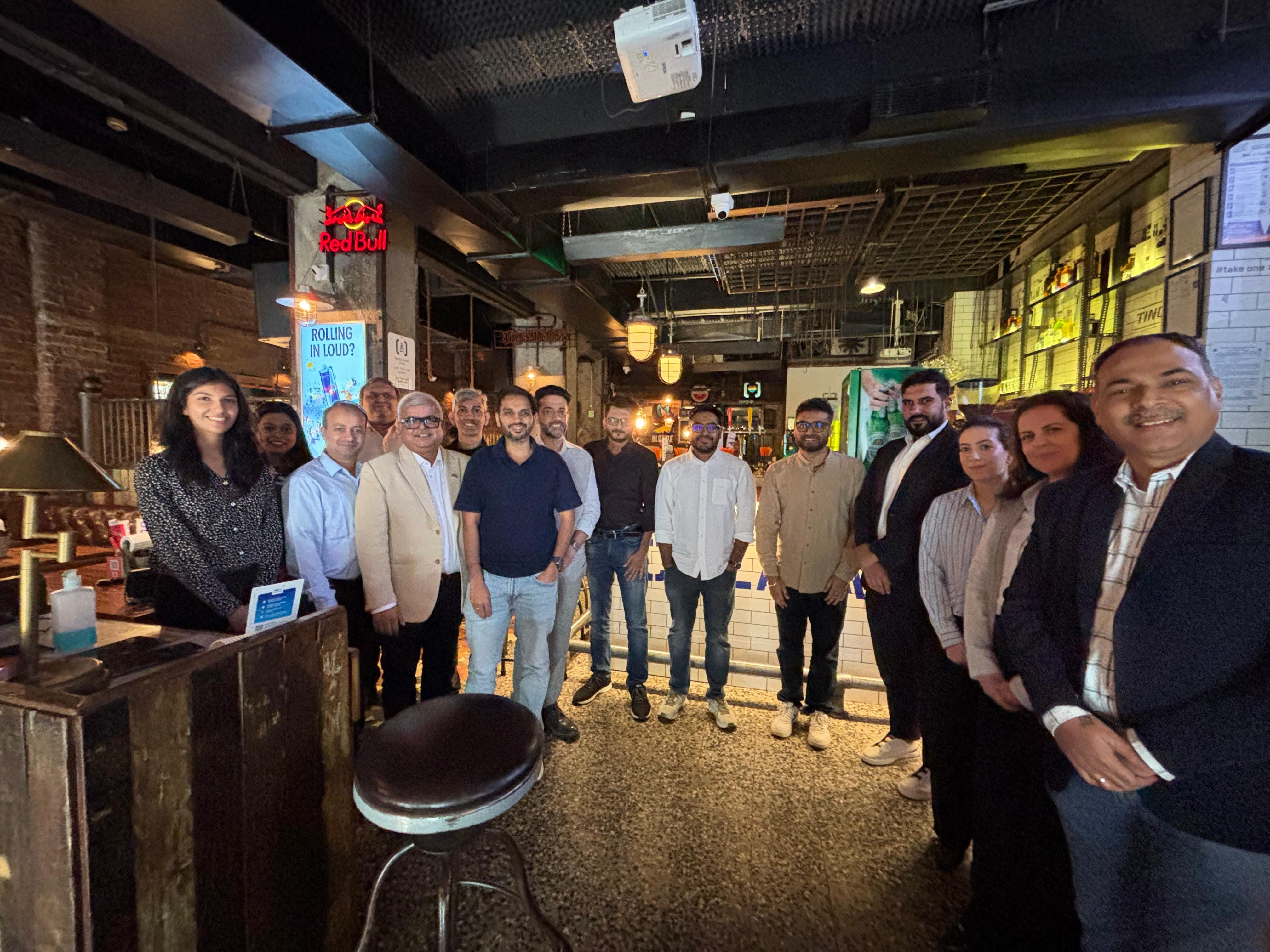
It was a pleasure hosting the Hub71 leadership in India, with Dealflow IQ, VBC and Taghash jointly organising this private, invite only gathering in Mumbai. The timing aligned with the UAE India CEPA Council Start-up Series taking place in Delhi and added further relevance to the discussions.
The evening brought together a focused group of Indian fund managers, CXOs and investors for an in-depth conversation on how the India UAE corridor is evolving and what this means for venture capital and high growth companies on both sides.
The delegation from Hub71 included Ahmad Ali Alwan (Chief Executive Officer), Mohammed Alkhoori (Head of Marketing and Communications), Helen Bachir (Head of Special Projects and Operations), and Aya Hamoodi (Value Creation Lead). Their participation was significant given Hub71’s growing role in the region’s technology landscape.
Established in 2019 within Abu Dhabi Global Market and backed by Mubadala and other Emirate institutions, Hub71 has developed into a leading technology ecosystem, supporting more than 300 startups that have collectively raised over 2 billion dollars and achieved commercial traction across sectors such as fintech, climate technology, enterprise software and digital assets. The platform now functions as a strategic entry point for companies that want access to the GCC, Africa and Europe.
Across the morning, a few consistent themes stood out.
The corridor is no longer only about capital. The India UAE relationship is shifting from being just a capital bridge into a genuine two way innovation bridge, where talent, founders and ideas move in both directions. Indian founders are now using Abu Dhabi and Dubai as strategic bases for entering the Middle East, Africa and Europe, while UAE based investors and corporates are looking to India for technology, product depth and engineering scale. Hub71’s recent cohorts already include several Indian founded companies.
Soft landing changes the economics of expansion. Entering a new market involves operational complexity that most early stage companies underestimate. Regulatory approvals, free zone decisions, sector specific licensing, banking, visas, compensation structures and customer acquisition cycles all add time and cost. Partners like Hub71 reduce this friction by providing a predictable landing environment, access to corporate partners, visibility with regulators, and practical support during the first six to twelve months of expansion. This transforms cross border growth from a high risk experiment into a repeatable, structured playbook. Companies can focus on validating their product and building revenue rather than navigating administrative barriers.
There is clear white space in specific sectors. Deep tech, climate and energy transition, fintech infrastructure, supply chain technology and health tech stood out consistently as the most promising domains for India UAE collaboration. India brings research strength, engineering talent, digital public infrastructure and cost effective product development. Abu Dhabi brings patient capital, regulatory clarity, sector specific incentives and strong access to regional markets. Together, these strengths create an environment where companies can design solutions that are global from day one. The opportunity is not to build in India first and expand later, but to architect companies that are built for two markets at once, using the corridor as a strategic advantage rather than an afterthought.
We look forward to hosting more such closed-door meet-ups in the near future. Stay tuned to receive updates on this front.