

India, on every conventional metric like participation, execution efficiency, digital access, Indian markets have transformed. Retail ownership has crossed thresholds once considered aspirational. Trading volumes are at historic highs. Technology and settlement rails move capital with unprecedented speed.
And yet, if you step back, something feels… incomplete.
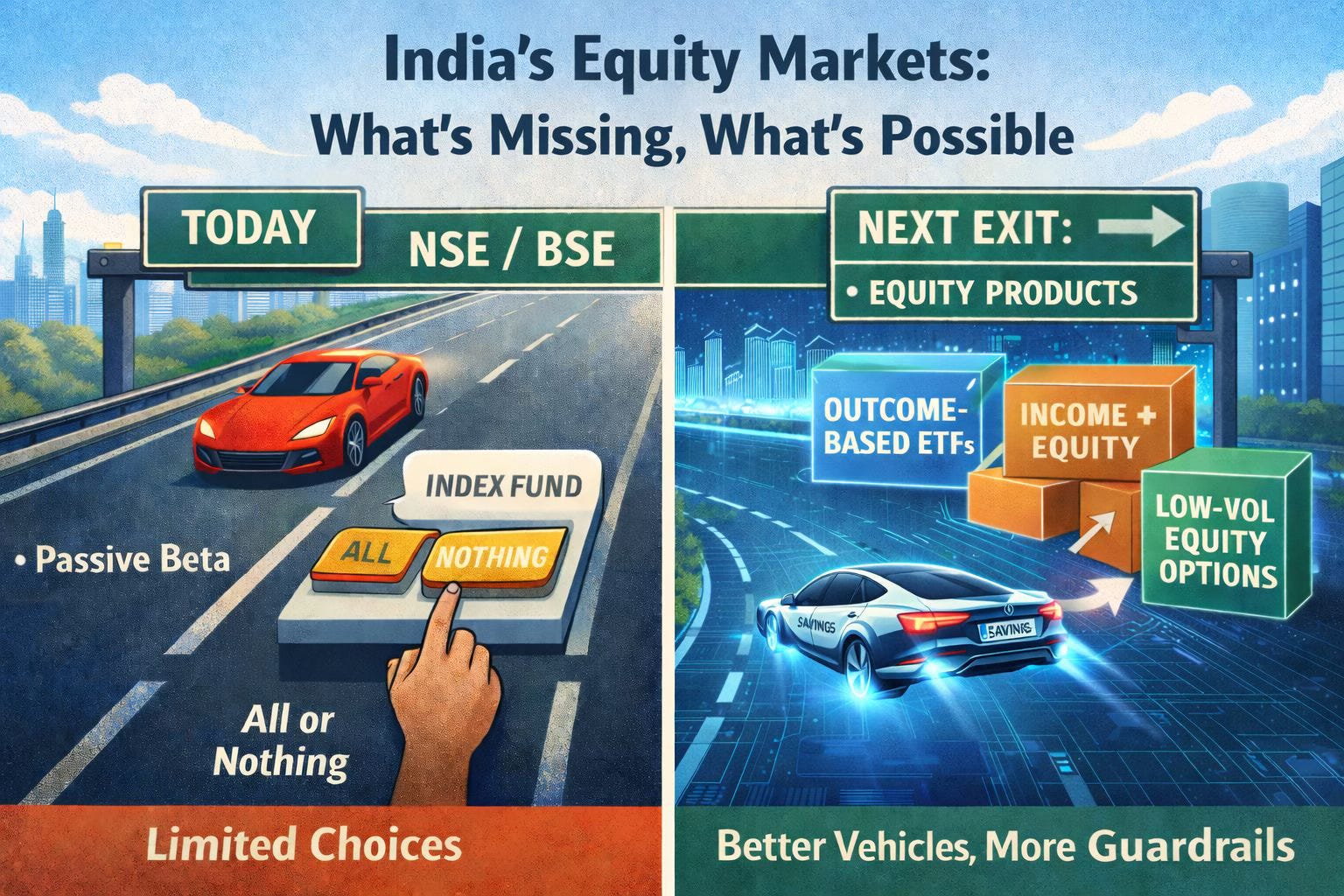
We have built incredibly high capacity highways for capital. But we still offer most investors only a couple of destinations: a vanilla long only exposure, or the high octane slopes of derivatives. That narrow product shelf is shaping investor behaviour in ways few policymakers have yet fully acknowledged.
SEBI’s recent tone on deepening cash markets, on derivative maturity, on regulated innovation isn’t just housekeeping. It’s a strategic nudge. India doesn’t lack participation. It lacks carefully designed participation options that convert “access” into durable wealth creation outcomes.
Participation Is Not the Problem, Product Depth Is
It’s worth distinguishing two separate dimensions:
1) Market Access & Infrastructure
Digital onboarding has lowered barriers. Broker apps bring retail into equity markets in their millions. Transaction costs and frictions have collapsed. SEBI and market infrastructure reforms have democratized entry like never before.
That’s a structural achievement.
2) Product Availability & Investor Outcomes
This is where the gap remains.
At present, listed equity products in India cluster at two poles:
Passive beta exposure via index funds and ETFs
Derivatives trading, often shorttenor and leveragecentric
For example, an investor who simply wants modest returns with some downside protection has no straightforward listed product to choose from. Instead, they often end up buying weekly options or experimenting with option strategies they don’t fully understand not out of speculation, but because the product shelf doesn’t offer a safer alternative.
Or anyone who has seen SIP investors panic-sell during sharp corrections knows this problem well. Often, it isn’t lack of belief in equities, it’s the absence of products that help them emotionally and financially tolerate volatility.
This is not a criticism of derivative markets, they serve liquidity and risk transfer functions but derivative dominance channels much retail activity into instruments that demand sophistication, discipline, and risk control most investors don’t yet possess at scale.
Mutual funds in India do offer intermediate options, low volatility funds, quality and factor strategies, hybrid products, some covered call vehicles and that breadth has expanded investor choices inside the open-ended fund ecosystem. However mutual funds help investors allocate capital and listed products determine how the market itself evolves, through transparent price discovery, structural comparability, intraday liquidity, and clearly defined payoff profiles that become default choices on broker screens. When that shelf is thin, behaviour naturally concentrates around whatever is visible and easily accessible: short-tenor trading.
That gap matters. Because product availability, not access alone, determines how people stay invested. People don’t panic because they opened T+1 accounts faster than a generation ago. They panic because they don’t have structures that help them ride cycles with clarity.
Why Product Design Shapes Behaviour at Scale
When most available choices are either “full beta” or “DIY leverage,” investors will:
Try to engineer their own payoffs
Lean on familiar, easily accessible tools like short options
Drift toward very short horizons and reactive trading
Regulatory messaging around derivative quality and longer maturity tenors should be read in that context. It’s not just about controlling risk in derivatives. It’s about nudging the market toward instruments that encourage healthier participation. Restrictions and warnings only influence marginal decisions. The suite of products available influences behaviour at scale.
In global markets where the equity product shelf is deeper, participation doesn’t just happen, it persists:
In the US, defined outcome ETFs, covered call wrappers, direct indexing, fractional ownership, and factor strategies allow investors to express nuanced risk preferences in simple, transparent packages.
Europe’s listed structured products market provides standardized payoff profiles with clear disclosures.
Japan’s listed ETF and JREIT ecosystem integrates equity participation with long term household savings behavior.
Hong Kong and Singapore complement cash markets with exchange traded structured products that are regulated and transparent.
Across these markets, investors can choose how they participate in growth, income, buffered, capped, low volatility without being forced toward speculation or daily expiry cycles.
What India Could Build, A Realistic Roadmap
India does not need derivatives like complexity masquerading as products. It needs clarity, structure, and choice that sit comfortably within a listed environment:
1) Outcome Oriented Index Products (Listed ETFs with Guardrails)
Products that define a payoff range over a fixed tenor: participate in most of the upside up to a cap, cushion some downside up to a limit. Not riskless, just clearer.
2) Income First Equity Products (Listed CoveredCall / BuyWrite Wrappers)
Equity exposure with explicit income focus and disclosure of upside caps, not designed to maximize speculative returns but to smooth participation.
3) Factor / LowVolatility Listed Products
Passive products that tilt toward lower drawdowns and smoother returns, ideal for systematic SIPstyle investing without the binary risk profile of pure beta.
4) Standardized Longer Tenor Equity Participation Structures
Products designed for meaningful horizons (six months, one year), nudging participants toward longer engagement and away from zeroDTE reflexivity.
5) Payoff Based Labelling and Transparency
Labels that reflect structure: “capped upside with buffered downside,” “income-oriented equity,” “low volatility tilt,” etc. Investors should be able to compare apples to apples, not wrestle with opaque marketing.
These are not foreign concepts. They are the next logical step for India’s listed markets.
Why Now Matters
Policy signals from SEBI and the Finance Ministry converge on one theme: stability through participation that lasts beyond the next expiry day.
Two policy signals stand out:
SEBI Chair on priorities: deepen cash equities (capital formation) and raise the bar for innovation, lower friction, widen opportunity, manage risk.
FM on participation and stability: retail investors acting as a stabilizing foreign implicit endorsement of broader, longer term equity ownership.
When investors can match their goals with products that embed risk boundaries and predictable payoff shapes, markets gain:
Investor protection through structure
Greater persistence of household ownership through cycles
Healthier price discovery and durable liquidity
Participation is necessary. But participation that survives drawdowns and cycles now that’s durable.
The Bottom Line
India’s next frontier in equity markets isn’t more volume.
It’s better product design. By widening the listed equity product shelf, without sacrificing transparency or simplicity, India can turn its retail boom into sustainable wealth creation architecture.
And if SEBI’s recent signals are read in this light, they’re not just about regulation. They’re about design. They’re about shaping the “how” of participation, not just the “who.”
The next decade of India’s equity story will not be won by access alone. It will be won by products that make participation stick.